Industrial IoT solutions to monitor Overall Equipment Effectiveness (OEE) in machines
How industrial IoT solutions from IoT Monitor improve availability, performance, and quality to optimize OEE in Chilean plants.

Co-Founder AHORRO ENERGÍA & IoT-MONITOR
Understanding Overall Equipment Effectiveness (OEE) in Chilean industry
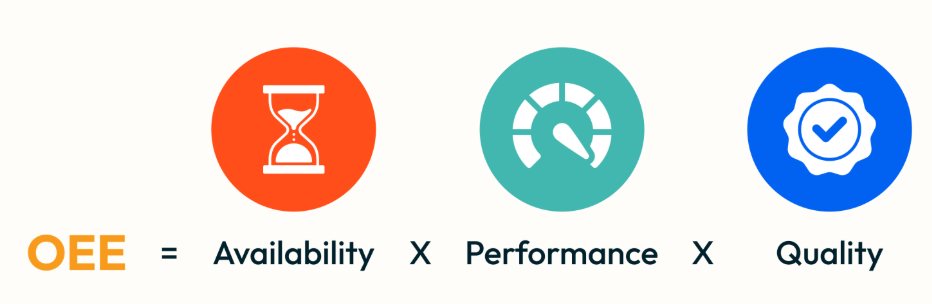
OEE is the core KPI that shows how effectively each machine is used in a production line. It combines Availability, Performance, and Quality in a single metric. At IoT-MONITOR we design our solutions around OEE so management and operations can align using the same language.
Low OEE usually hides issues such as unplanned stops, micro-stops, reduced speed, and rework. With industrial IoT sensors and real-time dashboards, these losses become visible and can be attacked with concrete improvement actions.
How to calculate OEE
Calculating OEE requires three components: Availability, Performance, and Quality. Each component is built from operational data that an industrial IoT platform can automatically capture from machines and PLCs.
Availability = (Operating Time / Planned Production Time) × 100. It includes all planned and unplanned stops that reduce effective production time.
Performance = (Ideal Cycle Time × Total Count) / Operating Time × 100. It reflects whether the line is running at target speed or if there are losses due to micro-stops, slow ramp-ups, or bottlenecks.
Quality = (Good Count / Total Count) × 100. It measures the impact of rework and scrap on final productivity.
Final OEE is the product of these three factors. IoT-MONITOR automates this calculation for each asset, line, and plant, giving clear visibility to supervisors, maintenance teams, and management.
The role of IoT in industrial automation and OEE
Industrial IoT (IIoT) connects sensors, PLCs, and machines to the cloud, capturing production, energy, and condition data in real time. This connectivity layer is the foundation of any robust OEE strategy.
With IoT-MONITOR, field data is integrated into a single platform: cycle times, piece counts, machine states, alarms, energy consumption, and process parameters. This enables data-driven decisions instead of manual spreadsheets and estimates.
Benefits of IoT-based solutions in OEE monitoring and improvement
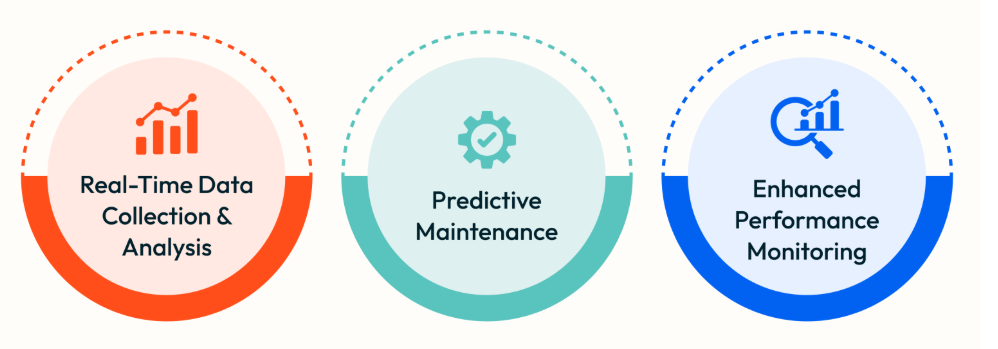
A well-designed industrial IoT solution turns raw signals into actionable indicators. At IoT-MONITOR we focus the platform on three main benefits for OEE: real-time visibility, predictive maintenance, and detailed performance monitoring.
Real-time visibility enables instant detection of stops, bottlenecks, and quality deviations. Predictive maintenance reduces unexpected failures by analyzing vibration, temperature, and operating hours. Performance monitoring helps close the gap between theoretical capacity and actual output.
Improving Availability with industrial IoT
Unplanned downtime is the main enemy of OEE. By connecting critical machines to the IoT-MONITOR platform, maintenance teams receive early alerts when sensor readings or PLC states show abnormal patterns.
This allows interventions to be scheduled in controlled windows, reduces surprise failures, and optimizes use of maintenance resources. Root-cause reports help prioritize investments in equipment and process improvements.
Ensuring quality with IoT
Quality becomes a live variable instead of a final result. By integrating reject counters, process sensors, and lab data, the platform can correlate operating conditions with product defects.
Plants can adjust parameters in real time, standardize best practices, and reduce waste. This increases the Quality factor in OEE and directly improves profitability.
Typical OEE and IoT use cases in Chile
In sectors such as food and beverage, mining, manufacturing, and logistics, OEE measurement with IoT has helped reduce downtime, stabilize throughput, and improve on-time delivery.
By implementing progressive sensorization and line-specific dashboards, Chilean plants can move step by step towards a more predictable, traceable, and competitive operation.
Challenges when deploying IoT solutions for OEE and how to address them
Key challenges in industrial IoT projects include integration with legacy equipment, cybersecurity, and internal change management.
IoT-MONITOR tackles these issues with open architectures, industrial gateways that support multiple protocols, and security best practices from edge to cloud. We also support operations teams with training and local expertise.
The future of industrial IoT for OEE: advanced analytics and automation
The next step for OEE optimization combines IoT with advanced analytics, machine learning, and automatic operating rules. As historical data grows, the platform can anticipate failures, recommend process changes, and prioritize interventions.
For Chilean plants this means moving from reactive to proactive operations, supported by data-driven recommendations instead of only individual experience.
Why choose IoT Monitor for your OEE initiatives
IoT-MONITOR specializes in connecting industrial assets in Chile to deliver full OEE visibility from the shop floor to management. We design, deploy, and operate tailored solutions that fit each plant’s reality.
Our approach combines robust industrial hardware, a modern monitoring platform, and continuous support. The goal is clear: increase availability, performance, and quality, improving operational results in a measurable way.
Conclusion: IoT as a pillar of OEE in modern plants
Industrial IoT solutions are now central to monitoring and improving Overall Equipment Effectiveness in modern factories. By delivering real-time data, enabling predictive maintenance, and strengthening quality control, they raise the competitiveness of operations.
IoT-MONITOR helps Chilean companies take this step in a safe and gradual way, starting with focused projects that are ready to scale. Contact us to evaluate your project.