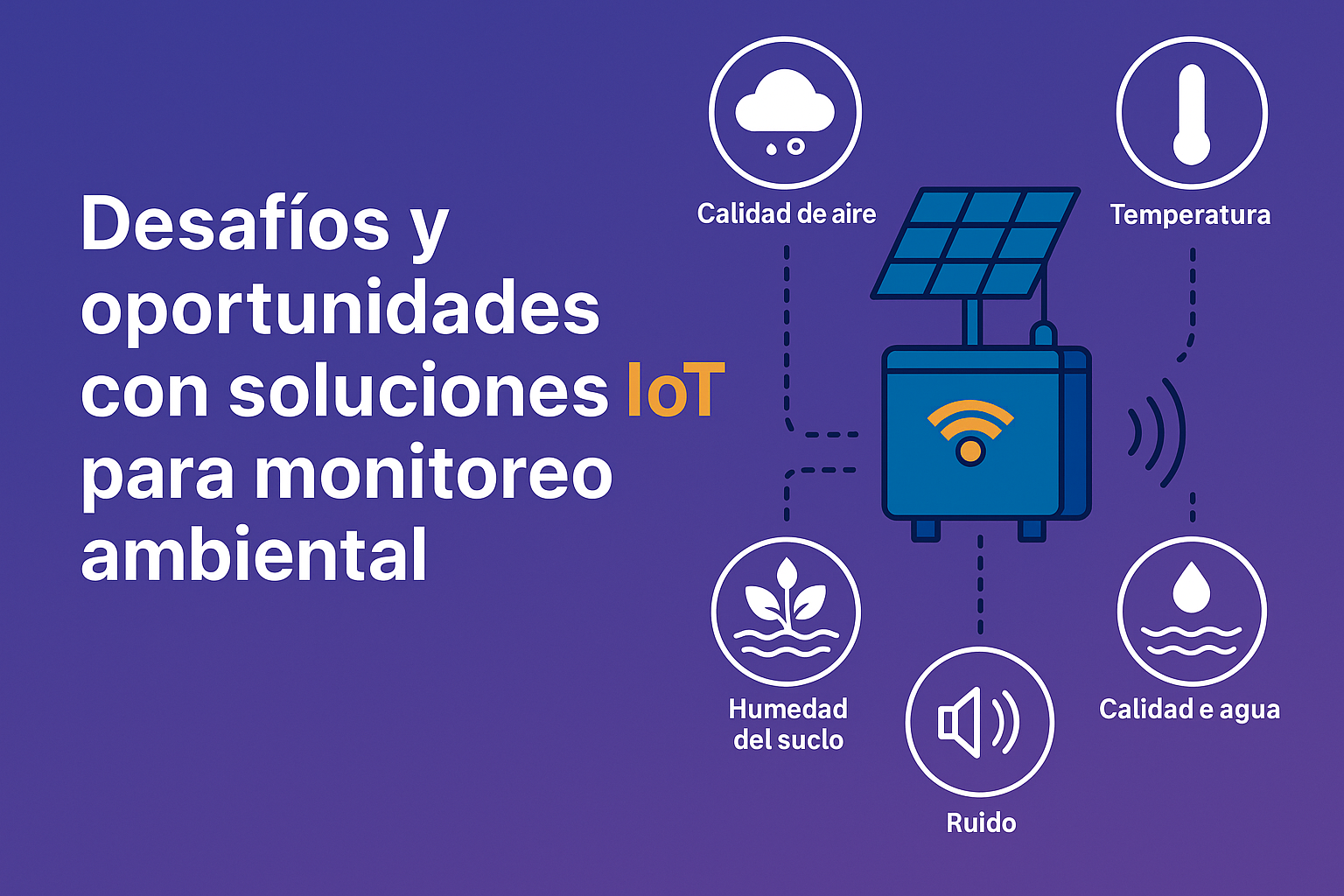
Challenges and Opportunities with IoT Solutions for Environmental Monitoring
How IoT-MONITOR helps cities and industries monitor air, water and noise in real time, reducing environmental risk and improving decisions in Chile.

Co-Founder AHORRO ENERGÍA & IoT-MONITOR
What is IoT for environmental monitoring?
In environmental monitoring, the Internet of Things connects distributed sensors with a cloud platform. These devices measure air quality, water quality, temperature, humidity and noise, providing a continuous view of environmental conditions.
With IoT-MONITOR, cities, industries and utilities consolidate this data into clear dashboards, with real-time alerts and ready-to-use reports for environmental management and compliance.
Opportunities of IoT for environmental monitoring
IoT-based environmental monitoring solutions create new opportunities to anticipate risks and improve sustainability. Continuous monitoring replaces occasional sampling with permanent supervision of air, water and noise.
Key benefits include early detection of critical events, better use of inspection resources, and objective evidence for public and private decision-making.
1. Real-time data and continuous visibility
Sensors installed in the field send measurements every few seconds or minutes, closing information gaps between manual samples. This enables instant detection of pollution peaks, leaks, or sudden environmental changes.
Through IoT-MONITOR dashboards, responsible teams see maps, trends, and alarms in real time, prioritizing actions and resources based on actual environmental impact.
2. Higher accuracy and spatial granularity
Networks of distributed sensors provide more precise and localized measurements than a few fixed stations. Variations per street, sector, or discharge point are captured, which improves environmental diagnosis.
This granularity helps identify specific pollution sources and evaluate the effect of corrective measures or mitigation projects.
3. Scalable and cost-effective solutions
Modern IoT sensors are more compact and affordable than traditional laboratory equipment. Combined with wireless communications and low-power design, they support wide monitoring networks at controlled cost.
IoT-MONITOR enables small pilot projects that can later scale to more monitoring points without changing the core platform.
4. Predictive analytics and early environmental risk warnings
As environmental data histories grow, advanced analytics can anticipate poor air quality episodes, algal bloom risk or water scarcity conditions.
IoT-MONITOR uses predictive models to trigger preventive alerts and response plans, reducing impacts on health, the environment, and operational continuity.
Key challenges of environmental monitoring with IoT
Alongside its opportunities, IoT-based environmental monitoring presents technical and operational challenges that must be addressed from the design phase.
The most relevant include the volume of data generated, sensor calibration and maintenance, connectivity in complex locations, and cybersecurity along the data path.
1. Managing and assuring quality of large data volumes
A sensor network can generate thousands of records per day per monitoring point. Without the right architecture, this volume can quickly exceed storage and analytical capacity.
IoT-MONITOR applies edge processing and smart filtering to reduce noise, prioritize relevant events, and ensure that stored data has the traceability and quality needed for reports and audits.
2. Sensor calibration, maintenance and reliability
Outdoor sensors are affected by temperature, humidity, dirt and wear. Without maintenance plans, measurements can drift and lose accuracy over time.
IoT-MONITOR projects include verification routines, drift alarms and planned replacements to keep environmental information trustworthy.
3. Connectivity in challenging locations
Environmental monitoring often requires sensors in rivers, hills, rural areas or industrial zones with interference. Stable WiFi or cellular coverage is not always available.
IoT-MONITOR supports multiple communication technologies—such as cellular networks, LoRaWAN, or dedicated links—to ensure data reaches the platform with the required frequency and reliability.
4. Security and privacy of environmental data
Environmental data may be linked to critical facilities, public infrastructure or strategic assets. It is essential to protect devices, communication channels and the cloud environment.
The IoT-MONITOR architecture incorporates end-to-end security best practices, access control and event monitoring to reduce the risk of data manipulation or loss.
Typical IoT-MONITOR use cases in environmental monitoring
Common scenarios include air quality networks in cities, monitoring discharges into rivers and water bodies, and sensing agricultural fields to optimize irrigation and resource usage.
In all these cases, the IoT-MONITOR platform delivers centralized visibility, clear indicators and traceable evidence for regulators, communities and management teams.
Why choose IoT-MONITOR for your environmental monitoring projects
IoT-MONITOR combines robust hardware, flexible connectivity and a data platform tailored for environmental monitoring in Chile. We support clients from sensor network design through day-to-day operations.
Our focus is turning environmental data into action: clear alerts, simple indicators and useful reports for sustainability, compliance and operations.
Conclusion: using IoT opportunities to protect the environment
IoT-based environmental monitoring solutions transform a fragmented view of the environment into continuous, data-driven control. When implemented well, they reduce risk, support sustainability, and strengthen trust with communities and authorities.
IoT-MONITOR helps deploy these projects safely and at scale, adapted to Chilean conditions. Contact us to evaluate your environmental monitoring project.